Monday, 20 February 2017

Props and costume list

Props:
Crime board-The crime board is an essential prop in our thriller opening as it is the indication at the end of the opening that all is not well. It also leaves the plot of the film open, as in our previously planned opening it appeared like a trailer due to too much of the narrative being given away in the first two minutes. 
Cup of coffee-This shows that Lucy needs caffeine to keep herself sharp and that she is a hard working a determined character. 
Black handbag-Although this could be considered a mundane prop to use, the relevance of this prop is that it shows how casual Lucy's character is when it comes to investigating. It also gives the audience an indication that she is undercover. The purpose of the prop is to keep her notepad safe as it is essential to the investigation and the information will be used on the crime board later in the film. 
Flowers-The flowers will be used to show the 'remorse' Lucas shows? They will be placed on the grave aggressively to show the mixed emotions he shows due to his disorder. 
Car-The car will be used to show that Lucy has travelled to the church. It also shows that she is undercover as it is not a police car. This shows she does not want to stand out. 
Notepad and pen-This are essential as what she observes Lucas doing she writes down onto the notepad, this is then added to the crime board at a later date. 
Camera-The camera is used to take pictures of Lucas when Lucy is observing him. This is also transferred onto the crime board at a later date to record his behaviour. 
Watch-This is used as Lucy exits the car and checks the time. This leaves the audience asking why she does this. As it could be considered a nervous act as opposed to a confident one.

Costumes:
Lucy Barnes (Lucy)-Business suit, smart coat, hair in a professional looking bun, smart shoes, glasses. -The importance of this costume is that it is intended to send the message of authoritative, confident, official, credible, persuasive, and stable. This also contrasts with how Lucas is portrayed. The key elements are a more formal, dark coloured, structured outfit that is smart and sends a clear message. The idea of Lucy's hair being pinned up also send a clear message as this is commonly worn by business women and people of higher authority, it shows she has made an effort. It’s generally assumed that glasses make people appear more intelligent, although this is a clear stenotype and obviously, a pair of glasses do not make someone more intelligent the impression is given off which is a desirable quality for this character. The character makeup will be natural to relate to the official and smart costume and hair. 
Lucas Smith (Lucas)-Black top and trousers, black shoes, black coat. Black is associated with power, death, evil, and mystery. It is a mysterious colour associated with fear and the unknown (black holes). It usually has a negative connotation (blacklist, black humour  'black death'). Black denotes strength and authority; it is a very formal, elegant, and prestigious colour (black tie, black Mercedes). In heraldry, black is the symbol of grief. Also, an obvious use of the colour black in relation to costume, of course, would be a funeral. Although Lucas is going to appear smart in all black an element will have to allow him to appear unstable, to contrast against Lucy and relate to his illness, this could be achieved through the addition of makeup to make him look tired and scruffy hair. 


Hush flashback scene analysis


The scene shows Maddie being beaten by 'The Man' who is not named through the whole film. After watching the film I can give the background knowledge that throughout the two characters have struggled for dominance as Maddie has struggled to survive and escape her attacker. The setting of the scene is Middies’ front room, with very low lighting as the power has been cut off; the only light comes in waves from the disconnected fire alarm she used to distract her attacker. What makes this scene unique in my opinion is the sound, because Maddie is deaf and mute the film has been adapted to her point of view through most shots, this means that most of the film is silent, putting the audience is Middies’ shoes, which provokes fear and suspense as Maddie is in allot of danger. As Maddie tries to escape the man grabs her by her hair and throws her to the ground, this is shown in two fast-paced shots the second showing the man’s face as he carry's this out. The man then starts to kick Maddie in the stomach; in this intense and violent shot sequence, we see a shot reverse shot between the man and Maddie on the floor. The man then lowers to Middies’ level and straddles and begins to strangle her. We are then shown a shot from the man’s point of view as Maddie bites his arm in defence. A canted high angle then quickly shows both characters on the floor, this is followed by a point of view shot from Middies’ point of view of the man hitting her, this then returns back to the canted high angle and then again to Middies’ point of view. This fast-paced editing and repetition of the same shot builds up suspense and fear as it shows the audience how quickly the situation has escalated. The camera then draws attention to where Maddie is reaching in her struggle, a corkscrew laying on the floor. In desperation Maddie reaches to a wound she inflicted on the man earlier in the film, this has no effect and he continues to strangle her and starts to aggressively bang her head against the floor. Non-diegetic sound of Middies’ heart beating is then reintroduced, as the heartbeat begins to slow pictures begin to appear for just a second on the screen, between these millisecond snapshots of pictures of Middies’ childhood (her life flashing before her eyes) we are also shown point of view shots of both Maddie and the man, looking both up and down at each other until finally, Middies’ heart beat slows. It is at this point that as Maddie is on the verge of losing consciousness, she manages to grab the corkscrew that we saw in the opening of the film and stab the man in the throat, finally killing him. We are then shown a bird's eye view shot of the two character collapsed on the floor in similar outstretched positions, ending the scene. 


Tuesday, 31 January 2017

Side Effect story board

The opening shot shows the Universal Pictures title sequence followed by the same for Lionsgate entertainment, this is accompanied with our chosen soundtrack which builds up during the 43-second duration of these titles. The first shot shows Lucas in the chair in front of the white wall. The camera movement for this shot is a tilt as it moves from the ceiling to the chair. This is followed a shot zooming into his face. The series of shots that follows this is very unique, we took inspiration from something we saw in the split trailer. A series of three extremely short shots showing different angles of the actor's face, this was accompanied by a high-pitched sound to increase tension and suspense. The next shot will show Lucas' hand tapping on the arm of the chair again building suspense as it is as if he is waiting for something or someone. The next shot will show a necklace being held in his hand, as he looks at this acts as a trigger for events in his past and he begins to uncontrollably shake this is only shown however in the shot of his shaking hand. The next shot shows a pan from one side of his face to the front. We decided to use this camera movement as it is as if the audience is walking around him in anticipation wanting to find out more. The shot will also focus on his head, the camera angle acts as a representation of the audience wanting to find out what he is thinking as these shots will be accompanied with the voice over. The last shot for this sequence shows Lucas looking up at the camera as the first voice-over ends with "What have I done." The screen then fades to black showing the end of that sequence of shots. A slow black fade into the next shot follows this, as the shot of Lucas standing in a graveyard looking at a grave slowly appears through the fade. The next series of shots show different angles from Lucas' point of view to point of view shots of the grave looking upward. This is followed by a shot of Lucas' hand outstretching showing the audience that he is agitated. Followed by a few close-up shots showing emotion. The next shot shows Lucas walking away from the grave and out of the graveyard. 

Filming 31/01/17


Today using the storyboard we had planned carefully as a group we began to film the shots that were staged infant of a white wall. Once we had worked out-out the order of the shots we were going to film and everyone knew what they were doing, it was simple to do it multiple times. We filmed every shot at least three times, just in case a shot was out of focus or didn't come out the way we wanted it to. As we have realised that even if someone thinks they are steady, the shots will be noticeably shaky without a tripod. However, for the majority of the shots, we did use a tripod to ensure the shots were steady and in focus. The lighting in the room was very dark and because we wanted to white wall to appear as bright, clear and ultimately pure as possible we turned on all the lights and opened all the blinds in the room which made a massive difference when comparing shots. This would also make it easier to edit the wall if we needed to when we are editing. Overall we were successful in the filming session as I find we learn a great deal more about how to improve our filming and editing skills every time we film. For example, we realised the importance of a tripod and the difference in the outcome of shots it makes. Also, we all took turns filming, this allowed us all to give our own unique view own the shots we were taking whilst still keeping to the decided on the layout (storyboard) we had created as a group. It also allowed everyone to improve on their filming skills. 


Wednesday, 25 January 2017

We Need To Talk About Kevin colour representation analysis


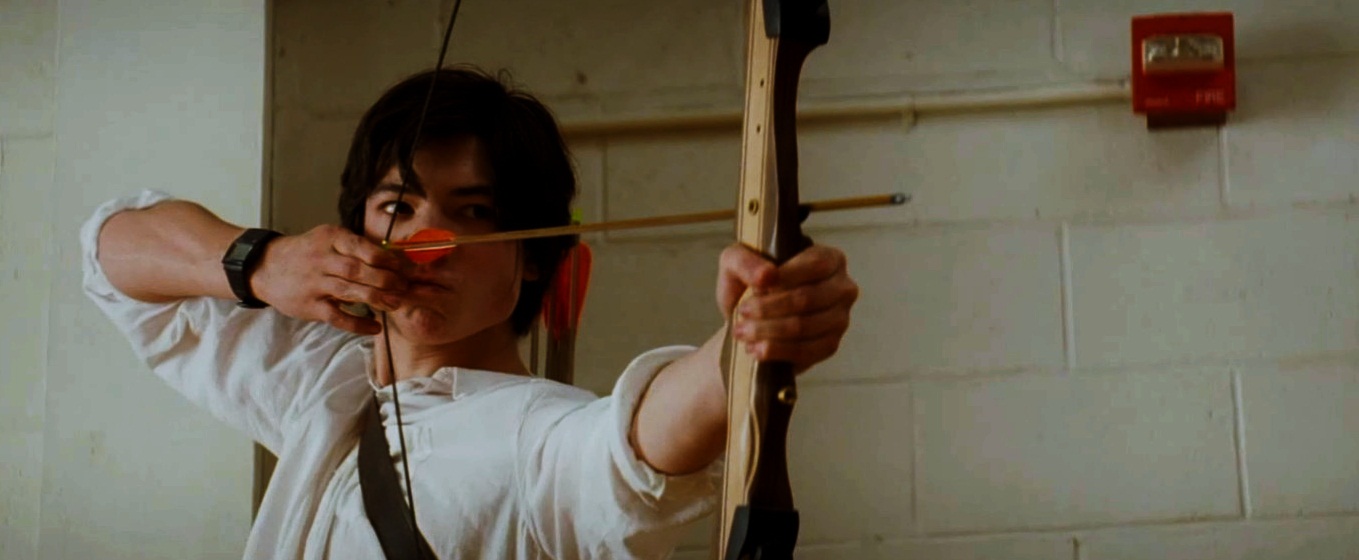
Something that I found interesting when watching the production was its representation of colour. In particular, the colour red, in almost every scene this colour is either made obvious or kept in the background. For example, in one scene in the kitchen there is a is very bright  kettle on the counter and it is red. In my opinion I found Kevin himself to be the strong use of the colour red which is highly symbolic of the inevitable bloodshed. Red is seen continuously throughout the film haunting Eva as a constant reminder of her son’s actions. We also see red during the dinner table scene on Kevin’s t-shirt which has a motif much like splattered blood. We also see that the diner that Eva is sat in is completely red and then the final scene in my chosen sequence shows Celia holding a large red bowl and when Kevin walks by the red tips of Kevin’s arrows. The first scene and the latter scene mentioned are memories of Eva’s and in both these scenes, the colour red is only featured slightly. In these scenes, red is not only symbolic of bloodshed but arguably more so of danger; a warning sign that was never acknowledged by Francis. However, the diner scene is Eva now reliving her disturbing past. She is surrounded by the colour red in this scene which symbolizes the fact that Eva cannot escape her memories of bloodshed and danger; they follow her, tormenting her. 


The colour yellow also used during the scene with Eva and Celia. Eva is cleaning Celia’s eye and the yellow, gooey liquid can be seen clearly on the ear buds, Celia’s bedroom walls have also been painting yellow. The yellow in this scene is symbolic of the yellow bull’s-eye on Kevin’s archery board which indicates that Kevin’s real target is not to hit the bull’s-eyes on the archery board but CeliaThis cinematic technique is particularly effective as it subconsciously affects the audience and builds up the tension ready for the final horrific incident. Another scene which focuses on the colour red would be the beginning scene in which Eva is dreaming. She is in a crowd of people; the faint sound of screaming can be heard this is to represent the Kevin’s victims, tomatoes are used to represent blood in the scene this is an odd choice but is very affective as the audience is aware of what the tomatoes are representing as using blood would make the scene too graphic. Eva appears to be content at the start of the dream being held up by the crowd. Soon after she is lowered down and victims start to throw the tomatoes over her, she is soon covered and struggling to get up this is a representation of the guilt and shame being thrown on her as she is Kevin’s mother and some may say responsible to an extent for his horrendous actions.


Fight Club IKEA catalogue scene analysis

From watching the film, I can give the background knowledge that the Narrator of the scene is without identity. He’s without friends or family, works a job he despises, and he sleeps so little that he fears he might die of insomnia. What he does have is an apartment overgrown with items from IKEA Home Furnishings. Things that take the place of relationships, laughter, and love. Early in the film, director David Fincher employs CGI in brilliant fashion to show the Narrator’s apartment being populated by IKEA one item at a time. Using editing and CGI we are taken on a tour of his apartment and it is as if time is sped up as we see the items slowly filling the room as the camera pans showing the narrator on the phone purchasing his next item of furnishing. It’s also perhaps the most important scene in the entire film as it establishes the film’s cynical take on consumer culture and how we are brainwashed into purchasing things we do not need and practically throwing wages away.


Skipping now to the end of the film the Narrator’s loyalty to and identification with corporate brands such as IKEA has been replaced by his loyalty to Fight Club, to Tyler, and to the primal, simplistic version of manhood that they represent. But Tyler is the ultimate hypocrite. He may talk of rejecting brand identification ("You are not your latte. You are not the car you drive."), but he’s really just a brand himself, as Fight Club represents violence and promotes the branding and socialisation of terrorism. The Narrator, now influenced by Tyler simply "setting up franchises," none of which are built to create or sustain what the Narrator is missing in life as discussed earlier (family, friends and love). In the end, the Fight Club is simply another ‘brand’ that contributed to the Narrator’s false sense of completeness. To conclude in my opinion when watching Fight Club for the first time I was unaware of the sharp turns and twists it would make throughout. The hidden messages the director send through the film leave a lasting impression. Therefore, in my opinion, the film relates to such a wide range of audiences, everyone can relate to the identification with corporate brands males and females of all ages.

Black Swan analysis

I have decided to analysis the film ‘The Black Swan’, in this blog I will focus on the storyline of the film as it strongly links to my groups chosen topic of schizophrenia as the main character suffers from the same mental illness. Something I noticed when watching the film is that throughout tension and suspense is built up through the thoughts Nina Sayers (the main character) and that in my opinion, everything that happens in the film leads up to the final scene. The final scene is the ending of the ballet.  It is Nina’s, first show in which she stars. Nina slowly started to lose her mind and become more like the black swan than the white swan.  Natalie Portman’s acting of this young lady who slowly becomes more and more delusional throughout the film was well done, as it was hard to tell if what was happening was just her delusional mind, or if it was a reality. My group can use this information as I can see that dedicated acting brings out the characters and plot of the film itself.
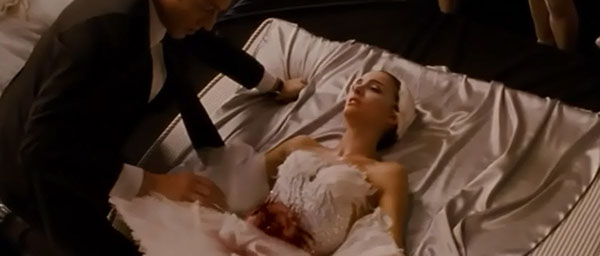
The final scene shows the beautifully choreographed last dance of the ballet.  The use of lighting in this scene stood out as strong artificial lighting as it is cast down in beams by the stage lights, this could be used to represent the pressure of Nina’s role and the pressure of her mental illness pushing down on her. This added to the emotion of the final act.  Once the ballet is finished, Nina is sprawled out on the mattress, as Thomas Leroy’s character, played by Vincent Cassel, who is her ballet coach comes running over to her screaming “They love you, they love you!”  He then calls her a princess and says “I always knew you had it in you.” We then see her stomach that is drenched in blood, which is a result of a delusion from a previous scene.  When Thomas asks her what she did, she replies “I felt it” he is confused, asks “what?” and she looks at the camera and says “I was perfect.”  We then see a point of view shot of her looking up at the theatre’s lights, and then the shot cuts back to her face as the lights get brighter in her face as it fades to white.  The ending is so fitting because the entire movie was Nina’s struggle to try to be perfect.  She ruined her own sanity in her mind to become the perfect swan with the lead role.  When she felt her part was threatened, there wasn’t anything she wasn’t willing to do to keep her part. It meant the world to her, and in the end, we can see in her eyes that it was all worth it to her; it was all worth it for her to feel like she achieved perfection in that moment.